I like the First Amendment. All the amendments are good, but the first is REALLY good. Being free to speak your mind is one of the many things that makes America great. It also helps reduce the need to use other amendments (like the second).
But what happens when you are exercising your First Amendment rights and someone in government tries to use their power to shut you down? Maybe a police officer arrests you (or threatens to) while you are engaged in a peaceful public protest. Maybe a government official threatens to punish you because of something you said.
It’s a common misconception that leaders, law enforcement, and public officials can NEVER break the law. That’s 100% wrong. America is a nation of laws, and in this country anyone who breaks the law can be held accountable. Even judges can go to jail if they commit a crime.
So what happens when a government official punishes you, or threatens to, because of something you said? Is that legal?
No, it’s not — based on a rule called “First Amendment retaliation”. I’m extremely familiar with this rule because I’m currently involved in a dispute with some government officials who, I believe, are guilty of illegally retaliating against me because of things I’ve said.
But let’s not get into that right now. Instead, let’s look at a recent example of what First Amendment retaliation is, and how courts can stop it.
This example involves Arizona’s senator Mark Kelly and our current Secretary of Defense, Pete Hegseth. A few months ago, Senator Kelly appeared in a short video with several other members of Congress. In that video, he explained that members of the U.S. military can refuse to follow illegal orders.
The statement that illegal orders can be ignored (which is 100% legally correct) was made in response to the Trump administration killing dozens of people (mostly in small boats) who were suspected drug smugglers. Many claimed these killings were illegal. Senator Kelly made a statement which simply explained that members of the military are not required to follow illegal orders.
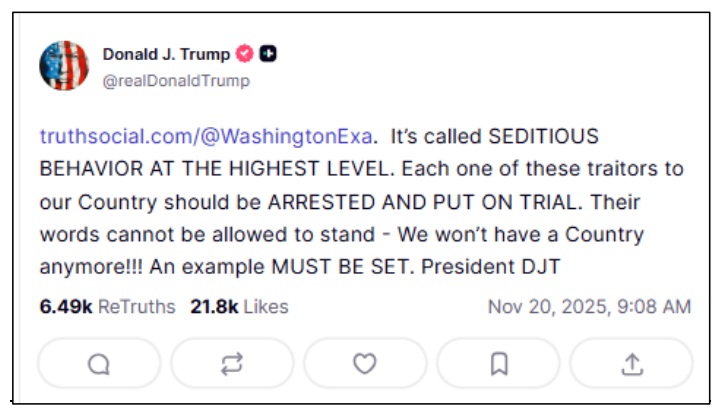
That statement infuriated Donald Trump. Trump posted statements on social media calling for Senator Kelly and his colleagues to be arrested and charged with treason (the Department of Justice later tried to indict Senator Kelly, but the grand jury refused to sign off on the charges).
In the middle of all this drama, Defense Secretary Hegseth took steps to “punish” Senator Kelly by demoting him (even though he is retired from military service) and reducing his retirement pay. To ANYONE watching this, it was clear Secretary Hegseth was retaliating against Senator Kelly for exercising his First Amendment rights.
That’s illegal. Government officials have lots of power, but they still must comply with the law. And the First Amendment is a law. So when government officials break that law (or even just threaten to do so), you can take them to court for it.
That’s what Senator Kelly did – he sued Pete Hegseth in federal court. The Complaint is a work of art. It lays out the facts and the law better than I ever could.
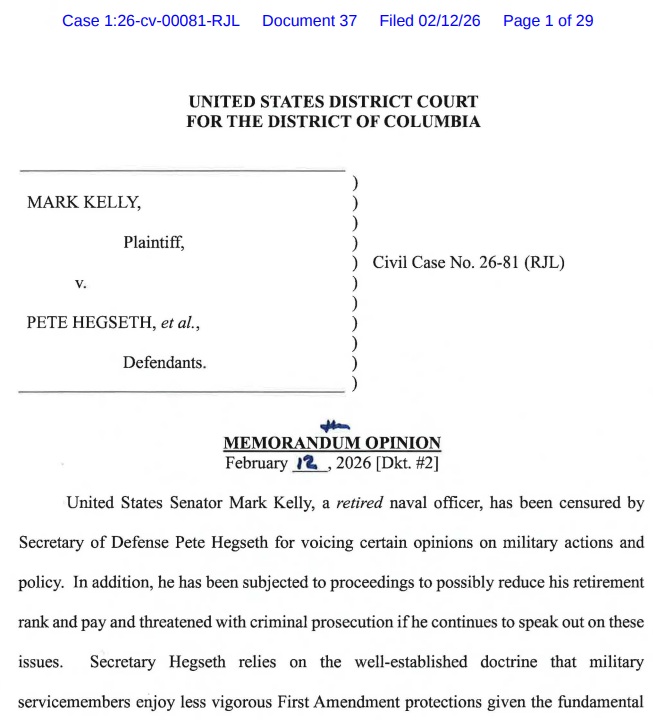
A few days ago, a Republican federal judge issued a ruling finding Hegseth (and, by extension, Trump) broke the law by retaliating against Senator Kelly in violation of the First Amendment. In its order, the Court explained how this stuff works:
To demonstrate First Amendment retaliation, Senator Kelly must show (1) he
“engaged in conduct protected under the First Amendment”; (2) Defendants “took some
retaliatory action sufficient to deter a person of ordinary firmness in [his] position from
speaking again”; and (3) there is “a causal link between the exercise of a constitutional
right and the adverse action taken against him.” Aref v. Lynch, 833 F.3d 242, 258 (D.C.
Cir. 2016).
Given the facts, this was an incredibly easy win for Senator Kelly. He spoke out on a matter of public concern. What he said was true, and it was clearly protected speech. In response, Trump and Hegseth took retaliatory action against him, based on Kelly’s speech.
Done. Game over. Once again, Trump tried to wipe his ass with the U.S. Constitution, and once again, he failed.
Because the First Amendment is a federal law, it applies exactly the same in all 50 states. Arizona’s courts have recognized the same claim using the same standards. See Arizona Students Association v. Arizona Board of Regents, 824 F. 3d 858 (9th Cir. 2016) (explaining: “To bring a First Amendment retaliation claim, the plaintiff must allege that (1) it engaged in constitutionally protected activity; (2) the defendant’s actions would “chill a person of ordinary firmness” from continuing to engage in the protected activity; and (3) the protected activity was a substantial motivating factor in the defendant’s conduct—i.e., that there was a nexus between the defendant’s actions and an intent to chill speech.”)
This legal principle is why I said I may sue the State Bar of Arizona (and more specifically, the “Bar Guy” who has been harassing me for nearly two years). The Bar Guy seems to have disappeared. I haven’t heard from him since last fall. But his threats (and his efforts to punish me for engaging in protected speech) still weigh heavily on me.
Just like Senator Kelly, I have a right to speak freely under the United States Constitution. The fact I am a lawyer does not change that, at least when I am outside of court. I absolutely agree courts have the power to restrict activity that would otherwise be protected by the First Amendment when people are in court; you can’t walk into a courtroom and start blowing a whistle or burning a flag, even though the First Amendment protects those things when done elsewhere.
But when it comes to comments made on YouTube, Twitter, or anywhere else, I have the same First Amendment rights as anyone else. It is illegal for the Bar Guy to threaten me over protected speech, and I have the right to take him to federal court so a judge can explain the law to him. I may still do that, but since he appears to have backed down (for now), maybe I’ll just focus my efforts elsewhere.