UPDATE – I’ve notified the PDJ of this issue: Notice of Filing Supplemental Authority.
If you’re following this, by now you understand Jim Lee’s position — the First Amendment doesn’t apply to lawyers. To me, that’s insane, but that’s exactly what Jim says:
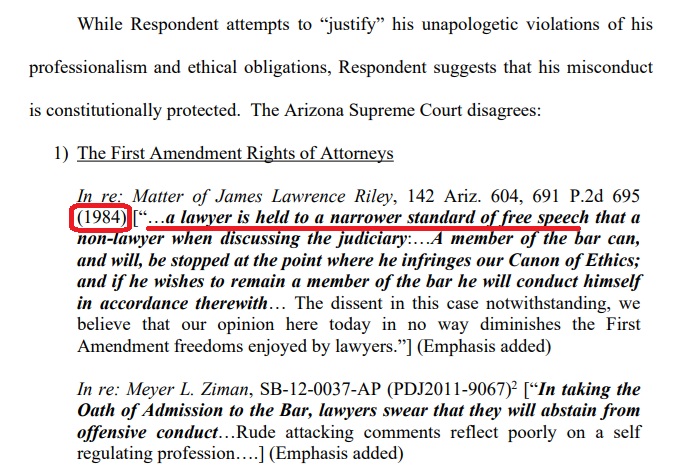
Now let’s drill down into this — Jim is citing a 1984 case from the Arizona Supreme Court which certainly DOES say that; lawyers don’t have the same free speech rights as others. Hmm, sounds kind of good for Jim, right?
Maybe not. If you go read that case (LINK), you will see to support that sentence, the AZ Supreme Court cited a case from 1957.
Folks, I was not alive in 1957, but I am pretty sure times were different then. Did you know — in 1957, Black people weren’t allowed to vote? Seriously — Black Americans weren’t allowed to vote until 1965. In fact, in 1957, interracial marriage was a crime (that wasn’t changed until 1967 in a case called Loving v. Virginia, 388 U.S. 1 (1967)). I am also pretty sure the Internet didn’t exist in 1957.
But sure — Jim Lee thinks 1957 was a better time, so of course rules from that bygone era still control today.
He’s dead wrong. The U.S. Supreme Court has said so consistently since then, including in one of my favorite cases from 1991, Gentile v. State Bar of Nevada, 501 U.S. 1030 (1991) (explaining, “At the very least, our cases recognize that disciplinary rules governing the legal profession cannot punish activity protected by the First Amendment, and that First Amendment protection survives even when the attorney violates a disciplinary rule he swore to obey when admitted to the practice of law.”)
But sure — let’s focus on a 1984 case from the Arizona Supreme Court while ignoring a more recent case from the United States Supreme Court. Because if we ignore things we don’t like, that means they don’t exist.
Except they do….and literally today — March 31, 2026 — the U.S. Supreme Court just reaffirmed MY view in an AWESOME case that spells complete and total doom for Jim Lee.
That case is Chiles v. Salazar, 607 U.S. ___ (2026). Here’s the Justia.com link, and if you want the original SCOTUS decision, here’s that link.
Chiles is a disaster for Jim Lee. It basically rips the guts out of Jim Lee’s entire “it’s still 1957” argument.
Chiles was not a bar discipline case. Rather, the case involved a licensed mental health counselor in Colorado named Kaley Chiles.
In 2019, Colorado passed a law prohibiting licensed counselors from engaging in “conversion therapy” with minors. What’s “conversion therapy”? The case explains: “any practice or treatment . . . that attempts . . . to change an individual’s sexual orientation or gender identity.”
Apparently Ms. Chiles felt this law restricted her ability to help her patients. As a result, she filed a lawsuit in federal court claiming the law was unconstitutional because: “these constraints strip her of her First Amendment right to speak freely with her clients in ways she believes might help them meet ‘their own goals.'”
Ms. Chiles LOST in the trial court AND in the Court of Appeals:
[T]he courts reasoned that Colorado’s law is best understood as regulating ‘professional conduct.‘ At most, they continued, Colorado’s law regulates speech only “incidentally” to professional conduct. As a result, the courts concluded, Colorado’s law triggers no more than “rational basis review” under the First Amendment, requiring the State to show merely that its law is rationally related to a legitimate governmental interest.
The United States Supreme Court accepted review, and today they reversed. The decision is overflowing with pro-Free Speech goodness, it’s hard to overstate how powerful it is.
Let me just start here:
The First Amendment “envisions the United States as a rich and complex place” where all enjoy the “ ‘freedom to think as you will and to speak as you think.’ ” 303 Creative LLC v. Elenis, 600 U. S. 570, 584, 603 (2023) (quoting Boy Scouts of America v. Dale, 530 U. S. 640, 660–661 (2000)). Often, speech may prove illuminating and inspiring. Sometimes, it can be misguided, offensive, or cause “incalculable grief.” Snyder v. Phelps, 562 U. S. 443, 456 (2011). But either way, the First Amendment protects the inalienable right of every individual to decide for himself “how best to speak.” Riley v. National Federation of Blind of N. C., Inc., 487 U. S. 781, 791 (1988). In this Nation, no official—“high or petty”—may command our tongues or silence our voices. West Virginia Bd. of Ed. v. Barnette, 319 U. S. 624, 642 (1943).
After a higher-level review of classic First Amendment rules, SCOTUS issued a clear, direct, and unmistakable rebuke of Jim Lee’s entire argument:
[T]he First Amendment’s protections extend to licensed professionals much as they do to everyone else. It’s a point we have since discussed at length in [National Institute of Family and Life Advocates v. Becerra, 585 U. S. 755, 767–769 (2018)] (NIFLA). There, California sought to require crisis pregnancy clinics to make certain statements to their clients. The State argued that its law did not trigger demanding First Amendment review because it sought to regulate only “ ‘professional speech’ ” by state license holders. 585 U. S., at 766–767. We rejected that move. By compelling clinics to speak the State’s message, the law regulated speech based on its content. Id., at 766. And, we held, California had failed to “identif[y] a persuasive reason for treating professional speech as a unique category . . . exempt from ordinary First Amendment principles.” Id., at 773.
Damn. Sorry Jim. I guess it’s not 1957 anymore…..it’s 2026, and the First Amendment still means exactly what it says — you have no right to punish me for my speech, and let me just remind you of two other things:
- You swore an oath to “support the constitution and laws of the United States and the State of Arizona.” You have violated (and are currently violating) that oath. You should STOP, immediately.
- It is a federal crime for anyone acting under color of law to violate another person’s constitutional rights. See 18 U.S.C. § 242. I admit while Trump is in the White House, the odds of you going to prison are low. But Trump will be gone in 2 years, and the statute of limitations for violating this law is seven years.