It’s Friday and I’m taking the afternoon off. I had a long deposition this week, among other things, so I am going to take my ATV out to the desert this afternoon for a ride. I used to ride nearly every weekend, but as you get older, these things take a back seat to life. But I still love outdoor time, especially in the winter, so off I go…
Four Peaks – The Tonto National Forest

Before I leave, I wanted to share a small “Bar Guy” update. As of January 16, 2026, there has been ZERO movement on his part. No charges, and not a word from the guy. He’s literally ghosting me.
The reason for this post is because I have a new theory about what the problem could be. It’s super-technical, but I think this could be correct.
Here’s the deal — I’ve tried to be very transparent about what the Bar Guy is charging me with. But I have also tried to respect the privacy rights of other people. So I haven’t shared every detail. That wouldn’t be fair or appropriate.
But one specific thing Bar Guy wants to charge me with is negligently presenting false evidence to the court. Now, let me be clear – I believe the Bar Guy is….well….he and I have VERY different views of the world and of the rules. I personally think if the Bar Guy didn’t work FOR the Bar, he would have been disbarred by now. But that’s just me.
Here’s the problem – there NO SUCH THING as negligently presenting false evidence to a court. There is no rule that says this (which seems to be the Bar Guy’s pattern – he makes up imaginary rules and then charges me with violating them).
The actual language of the rule (ER 3.3) is pretty clear:
ER 3.3. Candor Toward the Tribunal
(a) A lawyer shall not knowingly:
(1) make a false statement of fact or law to a tribunal or fail to correct a false statement of material fact or law previously made to the tribunal by the lawyer;
***
(3) offer evidence that the lawyer knows to be false. If a lawyer, the lawyer’s client or a witness called by the lawyer has offered material evidence and the lawyer comes to know of its falsity, the lawyer shall take reasonable remedial measures, including, if necessary, disclosure to the tribunal. A lawyer may refuse to offer evidence, other than the testimony of a defendant in a criminal matter, that the lawyer reasonably believes is false.
See that word “knowingly“? That word has its own definition set forth in another rule, ER 1.0(f) which says: “(f) “Knowingly,” “known,” or “knows” denotes actual knowledge of the fact in question. A person’s knowledge may be inferred from circumstances.”
Got that? The rule does NOT permit the Bar to charge a lawyer with negligently presenting false information to a court. The rule only applies when the lawyer has actual knowledge that the information is false. If a lawyer does NOT have actual knowledge, then the rule simply doesn’t apply (or they haven’t violated it since negligent conduct isn’t covered by the rule).
Jim Lee does not like rules he doesn’t agree with, so his ROI literally said (jaw on the floor) that he planned to charge me with the imaginary crime of presenting false evidence negligently…despite that position being utterly groundless and contrary to the plain text of the rule.
So here’s where I think Jim has run into a serious problem — he presented a report (basically a draft complaint) to the disciplinary committee, and of course the committee rubber-stamped every claim Jim Lee asked them to. That includes this silly “negligent” ER 3.3 violation.
But the forces of good have conspired against Mr. Lee. How so? Well, check this out — every so often, the State Bar of Arizona sends an email newsletter called “eLegal” (get it?) I’m sure most lawyers ignore this junk, but not me. I actually read the newsletter from top to bottom.
As few days ago, I got the new eLegal newsletter for January and was surprised to see a comment saying there were some changes to certain ethical rules. That seemed important, so I took a deeper dive (I was also intrigued by the fact the newsletter specifically mentioned ER 3.3). Hmm…what’s that about?
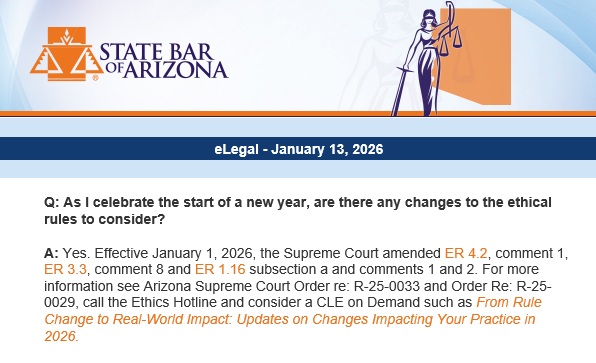
Well honk my meat — look at this. Effective January 1, 2026, the Arizona Supreme Court modified ER 3.3 by adding this tasty little nugget (it’s a comment under the rule, so the actual text of the rule doesn’t change, but the comments are basically the Court’s instructions on how the rule must be interpreted)01:
[8] The prohibition against offering false evidence only applies if the lawyer knows that the evidence is false. A lawyer’s reasonable belief that evidence is false does not preclude its presentation to the trier of fact. A lawyer’s knowledge that evidence is false, however, can be inferred from the circumstances. See ER 1.0(f). Thus, although a lawyer should resolve doubts about the veracity of testimony or other evidence in favor of the client, the lawyer cannot ignore an obvious falsehood. If a lawyer reasonably believes that evidence has been materially altered or generated with the intent to deceive the court, the lawyer has an obligation to conduct a reasonable inquiry before submitting the evidence to the court. The scope of the inquiry will vary according to the circumstances of each case, but factors to consider may include the probative value of the evidence, the value or importance of the case or issue, the source of the evidence, and what, if any, accessible, reliable, and affordable tools or methods are available to assess the evidence’s authenticity or integrity. If after inquiry the lawyer still does not know that the evidence has been materially altered or generated with intent to deceive, the lawyer retains discretion to submit the evidence to the court.
Rut-roh. Jim Lee have big problem. Jim Lee no happy. Jim Lee big sad.
He literally presented a legal position to the disciplinary committee that the Arizona Supreme Court has now expressly rejected. In fairness, that happened in August of last year, so this new comment wasn’t actually in effect (but really, all it does is explain what the rule already said – lawyers can’t submit evidence they KNOW is false, but if they’re not completely sure, it’s perfectly fine to submit the evidence and let the judge/jury figure it out).
I don’t think this rule was ever unclear. But Jim Lee tried to twist it into something totally different….but now the Arizona Supreme Court has nipped that bullshit in the bud. In theory, that means if Jim Lee were to actually file charges against me based on the ROI he submitted to the committee, he would be violating multiple ethical rules by pursuing a charge he knew was unlawful (and YES, despite what you may think, lawyers who work for the Bar CAN be charged with ethical violations).
SHIT, WHAT TO DO?
Look — is this really the reason Jim Lee is dragging his feet? I have no clue. Based on my contact with him, anything is possible. He doesn’t seem to care about truth, law or justice. He only seems to care about harassing and punishing people he doesn’t like. Sheesh, maybe he should go to work for ICE? Then he could just shoot me in the face rather than wasting everyone’s time.
Anyway, I have no idea what he’s doing….if he cared about ethics, I assume he would go back to the disciplinary committee and explain that he made a boo-boo. Maybe that’s what he’s doing? I have no idea.
But I do know the Arizona Supreme Court’s modification of ER 3.3 absolutely renders Jim Lee’s charge groundless. So if he does file that charge, you can bet I will not only ask the judge to toss that count, I will also ask the judge to refer Mr. Lee to the disciplinary committee.
The rule of law still means something. At least I think it does.
Anyway, off to ride….