Today is going to be BUSY. I need to file one more little thing with the PDJ, but then I need to start working on written discovery requests to the bar (document requests, interrogatories, and requests to admit). It’s hilarious because Jim Lee told the bar judge this case should be kept within the “tier 1” discovery limits (which applies to “simple”) cases.
Under tier 1, this is the limit for all discovery in the case:
Each side in a Tier 1 case is permitted 5 total hours of fact witness depositions, 5 Rule 33 interrogatories, 5 Rule 34 requests for production, 10 Rule 36 requests for admission, and 120 days in which to complete discovery.
So that’s it — for now, I get to ask Jim Lee FIVE questions (interrogatories). FIVE. Obviously I can (and will) ask the PDJ to raise those limits if needed. In theory, if Jim Lee is acting in good faith, he could voluntarily agree to raise these limits.
I won’t hold my breath.
But that isn’t the point of this post. The point is after reading the bar’s Reply ISO their Motion for Judgment on the Pleadings, a line jumped out at me that was honestly shocking:
As to Respondent’s second claim, incredibly, Respondent (an Arizona attorney of almost 22 years) suggests that the plain and unambiguous language of the order is simply too vague to be understood as it did not contain the words “IT IS ORDERED” or use language specifically “sealing” the prohibited documents. (emphasis in original)
Let me be clear — the person who wrote this just offered a textbook example of “Hanlon’s Razor”: “Never attribute to malice what can be attributed to incompetence.”
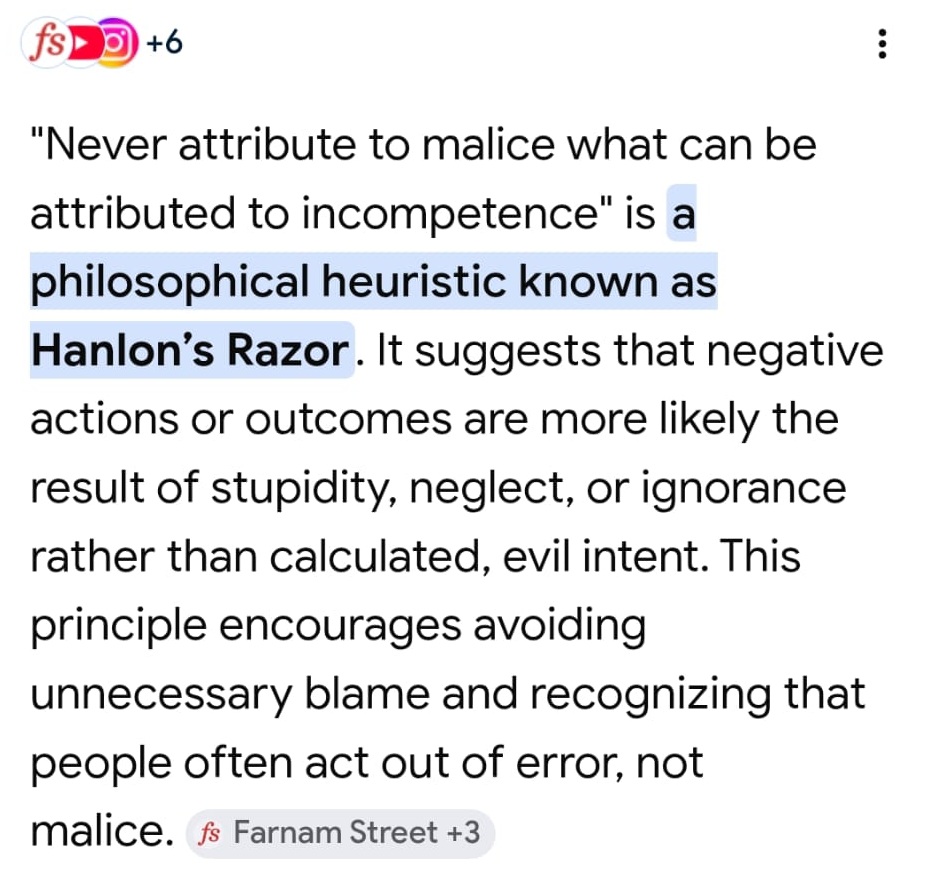
WOAH, did I just call the bar guy “incompetent”? Well, maybe….my first thought was this person was being intentionally dishonest…but then I remembered Hanlon’s Razor — you can’t always assume someone is evil. They might just be confused. Or uninformed. Or a combination.
Let me explain EXACTLY what I’m talking about….
The quote that shocked me was referring to the “LET THE RECORD REFLECT” issue. The back story: Judge Mata issued THREE orders DENYING each and every single one of Laura’s requests for confidentiality. Woodnick even argued it would be ILLEGAL for Mata to issue any order preventing the parties from talking about the case.
Somehow the bar doesn’t seem to understand this part, so let’s review…here are all THREE of Mata’s orders DENYING sealing/confidentiality:
- Order 1; October 18, 2023 (DENYING Laura’s request to seal)
- Order 2; February 15, 2024 (DENYING Laura’s request for confidentiality/protective order)
- Order 3; February 21, 2024 (see page 6: “IT IS FURTHER ORDERED denying counsel for Petitioner’s oral motion to reconsider regarding the ruling concerning Petitioner’s Motion for Confidentiality.”)
Oh, and let’s not forget this — as part of his successful fight against any/all confidentiality/sealing, in his objection (here) Woodnick argued that Mata could not legally grant that relief:
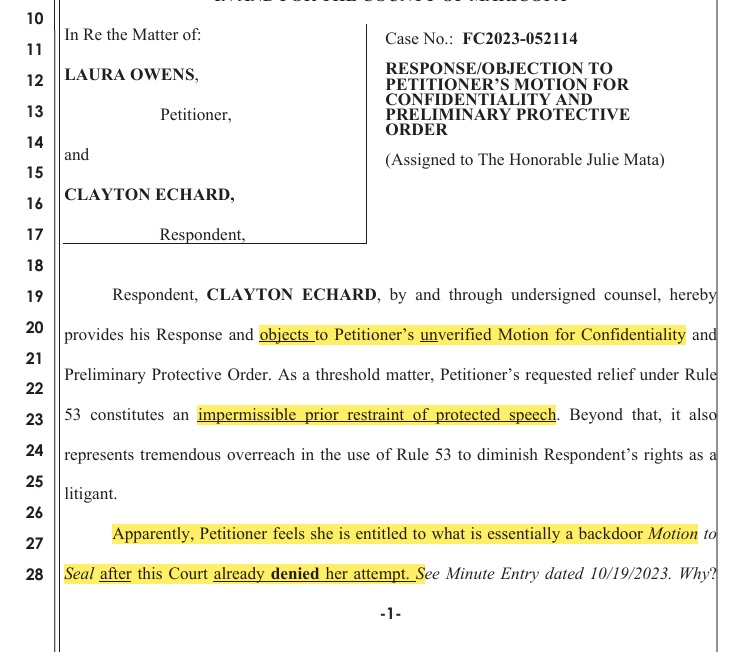
So let’s recap — Laura asked (begged) for confidentiality THREE times.
Mata denied ALL THREE REQUESTS.
Woodnick even told Mata it would be ILLEGAL for her to grant Laura’s request. And Mata apparently agreed.
Yet in the face of all this, the State Bar of Arizona claims a passing line that said “LET THE RECORD REFLECT” (and which said NOTHING about filing documents under seal) was actually an order which completely reversed all three of Mata’s prior orders, including an order DENYING Laura’s request for reconsideration, made within the same fucking order.
Folks, there is a legal rule that applies to this situation — it’s called the rule or canon of “constitutional avoidance”. What that means is basically this:
If any law/rule/order is ambiguous and can be interpreted two different ways – one view means the law/rule/order violates the constitution and the other view would not – a court MUST accept the view that does not violate the constitution.
Put another way: “In our constitutional order, a vague law is no law at all.” United States v. Davis, 588 U.S. 445, 447, 139 S. Ct. 2319, 2323, 204 L. Ed. 2d 757 (2019).
So, when a court is asked to look at a vague law/rule/order (it doesn’t matter which), the court only has one choice — it MUST construe that law/rule/order in a way that does NOT violate the constitution (if possible). Otherwise, if the only reading of the law/rule/order DOES violate the constitution, then that law/rule/order is VOID.
This is what the bar guys are SO CLEARLY missing.
Mata’s line about “LET THE RECORD REFLECT” was absolutely ambiguous, especially in light of her THREE prior orders (all of which were crystal clear). As I’ve explained, this language CANNOT be seen as requiring anything to be filed under seal, because Mata completely and totally ignored the specific family law rule that explains how those types of orders may be issued.
I’m sorry, but that’s not my fault.
I told the bar guys all of this long ago — my interpretation of the disputed line is that Mata was telling Woodnick: “Laura has asked for confidentiality, and I have denied those requests, but I better not see YOU (Woodnick) posting Laura’s medical records on Twitter.”
That is the only reasonable (and legal) way of interpreting what Mata said. Clayton never produced any medical records, so Mata was not telling Cory Keith what he could/couldn’t share. She was only referring to Woodnick, and I think what she meant was: Woodnick can’t post Laura’s medical records on social media, but either party CAN file them as exhibits attached to pleadings….which is exactly what happened.
The bar takes a different view. The bar seems to think in the middle of this high-profile case, Woodnick was allowed to issue press releases accusing Laura of fraud, and then for some unknown reason, after denying THREE requests for confidentiality, Mata sua sponte issued an order that said: “Laura – you are not allowed to say ANYTHING responding to or challenging Woodnick’s claims.”
That is literally EXACTLY what the State Bar of Arizona is claiming happened.
I’m sorry — that position is dead-center in the middle of Hanlon’s Razor. A court CANNOT legally order someone not to defend themselves in public, against public allegations someone else has made. Any such order would violate the U.S. Constitution and would be void.
That isn’t just my opinion; I cited this helpful case which agrees with me: Yanez v. Sanchez, 257 Ariz. 302, 306 (Ariz.App. 2024) (invalidating family court order which “prohibited both parents from posting on social media” and explaining: “The order here restricts future speech and is thus a prior restraint. That order is presumptively unconstitutional.”)
TL;DR – the bar’s reading of Mata’s order comment about “LET THE RECORD REFLECT” would mean Mata did something that violated the constitution. My reading does not violate the constitution. Therefore, I win.
P.S. Unconstitutionally vague orders are VOID, for EXACTLY the reasons this case has shown: “Vague laws transgress … constitutional requirements. They hand off the legislature’s responsibility for defining criminal behavior to unelected prosecutors and judges, and they leave people with no sure way to know what consequences will attach to their conduct.” Davis, 588 U.S. at 488.
So, if my reading of Mata’s order is correct, I win because I didn’t violate it.
If Jim Lee’s reading is correct, the order is VOID, and I win because I can’t be punished for violating an illegal/void order.