I just finished responding to Judge Mata’s argument that she enjoys judicial privilege (which is true, in a small, narrow way, and also true is the fact nothing I was seeking from her fell within that narrow privilege).
I also argued she waived privilege by talking to Jim Lee. I believe that’s why Jim refused to tell me if he had ever talked to her – because he knows she DID waive privilege, and he’s now trying to hide that fact from me and the judge. What an ethics hero.
BTW, Jim – please read Ariz. R. Civ. P. 26(b)(3)(A) – even if your discussions with Mata were work product, they are still discoverable as long as I have a “substantial need” for this information (which I do) and I cannot, without undue hardship, get the same information another way (which I can’t, since Mata is refusing to talk).
Anyway, as I was thinking about privilege and the ways it can be waived, Facebook was eavesdropping on me because this video recently turned up in my news feed. I don’t love this girl’s presentation (or her slightly-too-dramatic facial expressions), but the case she’s talking about is VERY interesting (and relevant): https://www.facebook.com/reel/1588976033236596
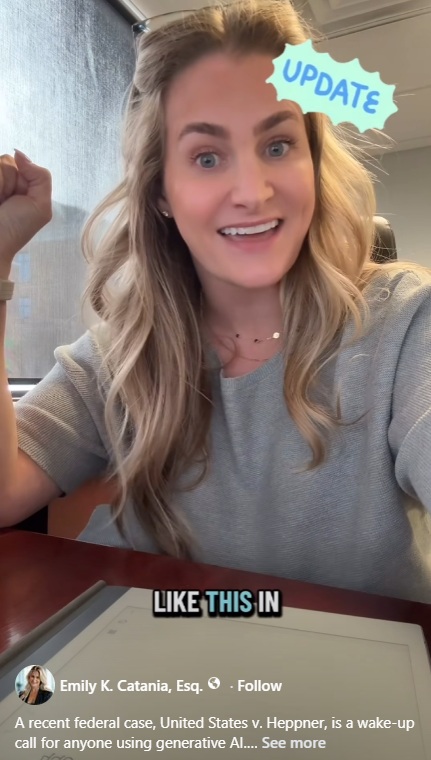
This is the case she is talking about: United States v. Bradley Heppner. The short version is if a criminal defendant/suspect uses ChatGPT (or other forms of AI like Claude) for legal research, or to get ideas about legal defenses/strategies, that stuff is NOT protected by attorney/client or any other privilege.
There’s a helpful Harvard Law Review note on this case, so I’ll just quote from that:
[A]fter Heppner “received a grand jury subpoena” and “it was clear . . . that [he] was the target of this investigation,” he used Claude “in anticipation of a potential indictment.” Without direction from counsel, Heppner input information he had learned from counsel into Claude and “prepared reports that outlined defense strategy [and] what he might argue with respect to the facts and the law.” He shared Claude’s outputs with counsel. Those outputs, in turn, influenced counsel’s strategy “going forward.” As Heppner’s counsel stated, Heppner had used Claude for the “express purpose of talking to counsel.”
Heppner asserted privilege over the AI documents. On February 6, 2026, the Government moved for a ruling that the AI documents were not protected by attorney-client privilege or the work product doctrine. After oral argument on February 10, the court granted the Government’s motion. On February 17, Judge Rakoff issued his opinion.
Judge Rakoff decided that the AI documents were unprotected by attorney-client privilege. He found that the AI documents lacked the first two, “if not all three,” of the privilege’s required elements. First, the communications were not “between a client and his or her attorney.” “Because Claude is not an attorney,” Judge Rakoff wrote, “that alone disposes of Heppner’s claim of privilege.”
This case is interesting for obvious reasons. A lot of people probably think if they have a legal problem, and if they ask for “advice” from ChatGPT or Claude or any other AI, that advice is somehow privileged. Feels like it should be, right?
Clearly, that’s wrong. It might be private in the sense ChatGPT won’t share your search queries without a subpoena. But if the cops grab your electronic devices and see your ChatGPT history, that isn’t going to receive the same protection as an actual conversation with a lawyer (which IS subject to extremely strong legal protection).