I am sure NO ONE (but me) will remember this, but last year we held a class on appellate jurisdiction here at Gingras University. Back then, I tried to explain that in most cases, a losing party can only appeal a “final order”. By definition, even when a court issues an order which looks final, that order can’t be appealed unless it meets the legal definition of a final order.
In other words, “final orders” are special. But why? How?
I’ll paraphrase – final orders are ONLY those orders which completely and totally resolve the entire case, leaving no unfinished issues for the court to address. If an order looks final, but doesn’t completely resolve EVERYTHING, then it’s not final. That’s true even if a judge mistakenly says: “this is a final order”.
That exact thing happened in 2024. Judge Mata issued a document which said it was a final, appealable order….except it wasn’t (it left other issues unresolved).
Because you MUST appeal final orders, and you can’t take a chance of missing the deadline or being wrong about final vs. non-final, I appealed this “final order” even though I knew it wasn’t final. I actually raised this issue in the first Notice of Appeal I filed.
The Court of Appeals spotted this issue (correctly). It then made us go back to the trial court and ask for a correct final judgment. Which we did.
Why mention all this boring technical stuff now? Because — I’ve been getting multiple notifications about people saying the IAH ruling we received today is “not a final order“. As ALWAYS, these brilliant legal comments come from people who appear to have as much legal knowledge and experience as my cat.
So let me help ya’ll out…
IF this case was in family court, the IAH order we got today would clearly NOT be a final order. Why not? Because it doesn’t address other issues like fees. Since there are remaining issues for the court to speak to, this order could NOT qualify as final in a normal civil case nor in family court.
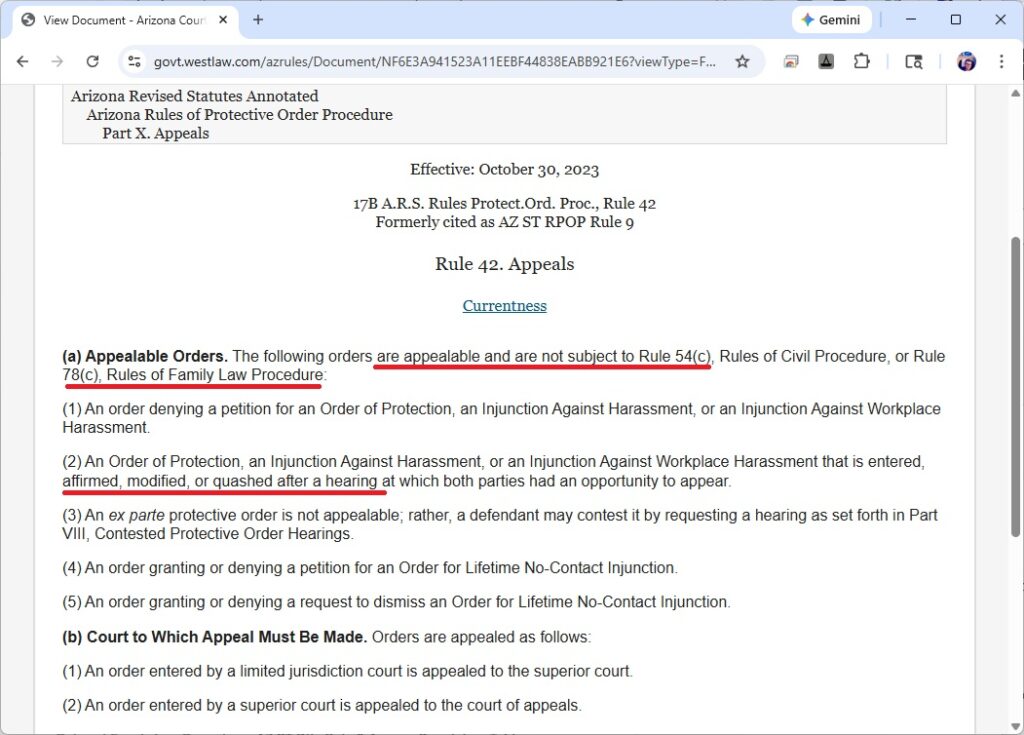
But this isn’t a civil or family court case. It’s a harassment injunction, and Arizona has special rules for this. Unlike in normal civil/family court cases, you CAN appeal from non-final IAH orders, including an IAH that is affirmed after a contested hearing.
So, what does that mean? Well, it means for appellate purposes, this IS a final order in the sense that it can be appealed (or, put differently, it’s just an order that can be appealed, notwithstanding the fact it wouldn’t qualify as final in a civil or family law case).
Does that mean the order is not final in the sense the judge *might* change her mind tomorrow? Sure, absolutely. My earlier blog comment said exactly that. And Trump might confess his Epstein-related crimes tomorrow.
Look – if the judge was going to vacate the IAH with this form, she could and would have done that. TODAY. It would not make any sense at all for her to affirm the IAH on this form, TODAY, and then issue a 2nd order tonight/tomorrow that reaches a different result. That technically COULD happen, but as a practical matter, no chance, Jeffrey.
TL;DR – You can call this order “non-final” if you want. But I wouldn’t do that unless you’re trying to win a lowest IQ contest.