After posting a video yesterday, it occurred to me I had lots more to say….but the thing I posted was already WAY too long, and maybe a little boring at the end. Sorry about that. I’m not a content creation pro. It shows, but at least I’m trying my best to improve.
While I would prefer to move on and never talk about this stuff again, the reality is the State Bar of Arizona is dragging me through this process involuntarily. AND, the Bar is making at least some claims against me which are 100% false. In that situation, I have no choice but to defend myself. That’s all I’m doing. Hardly seems unreasonable. What would you do in my shoes?
My video was focused on highlighting one false claim the Bar has made – i.e., that I violated the order granting Woodnick’s Motion to Compel. That’s a claim Woodnick himself never made, although the bar guy’s notes appear to indicate Woodnick claimed I DID violate the order, and then I lied in an effort to cover it up.
Since that’s false, this is not a claim I fear defending. It will take 2 seconds to get it tossed out on a dispositive motion. Fake claims never get that far.
But the bar is also making other false allegations. I will detail them ALL when/if the charges are ever finalized. Until then, let me reveal one other false claim the bar is making.
Everyone will remember the part of the Court of Appeals’ decision which said my “Rule 26 argument is not grounded in law or fact.” Based on that conclusory statement, the AZ bar guy said he also intends to charge me with various ethical violations.
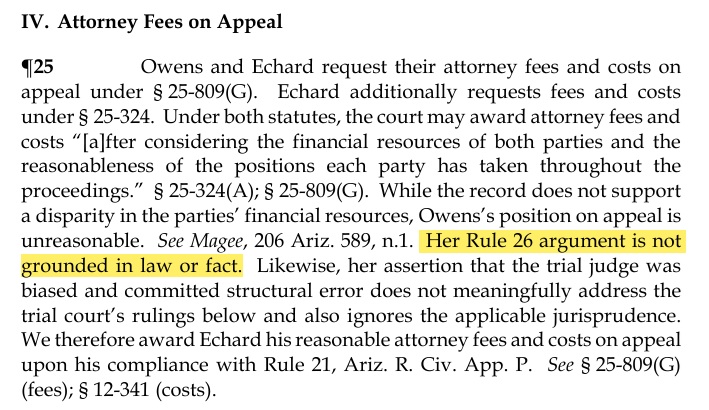
There are just two problems with this. First, the Court of Appeals never explained what “facts” I relied about that were not well-grounded. That’s hardly surprising because my appellate briefing was clear – the facts of the case were basically irrelevant to the issue of Rule 26. I said that repeatedly. So why did the Court of Appeals even mention this? It appears to be entirely gratuitous; i.e., the judge just carelessly tossed this line in to personally insult me, not for any valid reason.
During a phone call, Jim Lee told me he kind of agreed – this statement from the Court of Appeals doesn’t seem to have any support, at least as to the allegation that I somehow argued the appeal should be decided on facts that had no basis. The Court of Appeals judge who made that statement never explained what he meant as far as “facts” being not grounded.
Similarly, the judge who wrote the decision simply ignored the legal arguments that showed my Rule 26 argument was correct. I’m not going to fully re-hash this, but there was and is TONS and TONS of case law which said my position was 100% correct. Rather than talking about those cases and explaining why they didn’t apply, the Court of Appeals simply ignored them. Never even mentioned them.
As a lawyer who has done this work for years, I’ve seen this happen many times. When a judge can’t explain WHY your legal position is wrong, the judge will just ignore the law you cited. The judge won’t even discuss it. Just pretend it doesn’t exist. And most of the time, there’s not much you can do about it. But most of the time, the bar doesn’t charge you with misconduct just because a judge sees the law differently than you do.
In this instance, because the AZ bar is charging me with misconduct based on the conclusory statement by the Court of Appeals judge, guess what that means? Yup – the judge in question (Garye Vasquez) is now a witness. That means he will have to come to the bar hearing and answer questions about what he meant, since his words are the basis for a charge against me.
Technically, Judge Vasquez appears to be based in Tucson, and the rules don’t allow you to force a witness to travel outside the county where they live, so it’s possible we may have to take Judge Vasquez’ deposition in Tucson rather than making him come to Phoenix. I guess we will figure that out later.
Trust me when I say this — I think this is an unbelievable waste of the Bar’s limited resources. To charge a lawyer with misconduct because an appellate court judge disagreed with my legal arguments (without ever explaining why they were wrong) is just astonishing. It is, in my view, just further evidence that the State Bar of Arizona is broken and corrupt. I’d call it reckless and irresponsible, at best.
Having said that, while I WISH an adult in the room would stop this nonsense, at the same time, I cannot lie – I think it would be extremely helpful to have a chance to put Judge Vasquez on the stand and ask him, under oath, to fully explain what he meant.
What facts did I raise regarding Rule 26 which were not well-grounded? I can’t think of a single one. I’d love to hear him answer that.
I also intend to have Judge Vasquez read specific passages from the cases I cited, and then explain why those authorities did not apply. I expect the response will be eye-opening.
Everyone seems to think I am the one with my eyes closed. Maybe that’s true. But from where I sit, it doesn’t appear that way. So let’s shine some daylight on this and see what happens.
After all, I just raised the same arguments in response to a sanctions motion filed in another case. As I explained there (as I did here), there is voluminous and virtually unanimous legal authority that supports my position – you cannot simply end-run around the safe harbor provision of Rule 11 (Family Law Rule 26) by using other authority which doesn’t contain the same safeguards. Doing that (as happened here) renders the safe harbor “meaningless”. That’s why courts routinely reject that approach….except here.
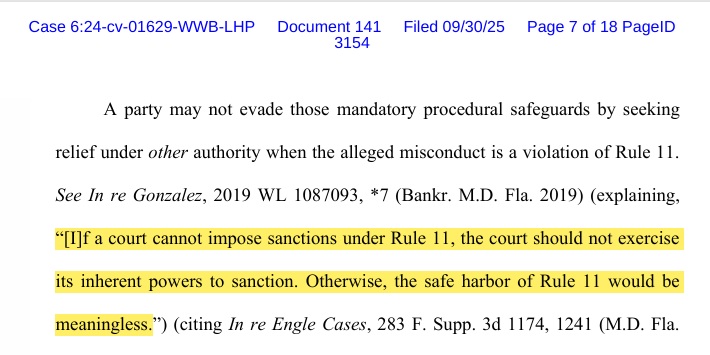
Based on the unpublished decision written by Judge Vasquez, the safe harbor provisions of Arizona’s Civil Rule 11 and Family Law Rule 26 are currently meaningless in this state. Under the “Woodnick Rule”, a violation of Rule 11/26 is no longer subject to any safe harbor at all. A party cannot correct an error and avoid sanctions, even though the rule says they can. Thus, the safe harbor literally serves no purpose at all. It exists only on paper. If it did not apply here, it would never apply in any case.
I cannot wait to sit down with Judge Vasquez and have him explain that one to me, while we carefully walk through case after case after case which says his position was simply flat wrong.