PREFACE – I am currently fighting with the State Bar of Arizona over certain ethical rules and how they may or may not apply to certain facts. This post is about a rule that is NOT part of that dispute. So the comments below are not intended to preview arguments I’m planning to make with the bar judge. They are just points I think are interesting enough to warrant discussion.
Now, for today’s commentary — Hi. Happy Halloween. 🎃
If you’re here, you are probably hoping to read about something else. Sorry to disappoint, but I’m not talking about that. I’m also done with social media (for now). I’m not reading anything online (for now). Not lurking in Discord (for now). Not even watching YouTube (for now), although I did see a certain music video tribute about two people, and I’m not gonna lie — it was pretty entertaining.
Oh, and real quick – a friend just sent me this cat photo a minute ago….and personally, I think it’s pretty cute. I love Aurora. She’s the best cat I’ve ever had.

Moving on — today I want to say a few words about something I think is weird, but important — the State Bar of Arizona doesn’t seem to understand its own rules. I have theories about why that’s happening, but for now I want to discuss to one especially clear and egregious example.
Like all states, Arizona has adopted a set of ethical rules which lawyers are required to follow. These are largely based on model rules created by the American Bar Association (ABA).
But Arizona’s rules aren’t identical to the ABA rules. Many states, including Arizona and California, tweak the ABA rules in various ways. Some rules are tossed, while others are modified (some heavily). Because different states have different rules, lawyer conduct may be perfectly OK in one state but may be unethical in a different state.
TRIVIA – the ABA model rules are taught in law school. If you want to practice law, in addition to passing the bar exam for each state you want to practice in, you also have to pass a separate test (called the Multistate Professional Responsibility Exam, or “MPRE”) which ONLY tests your knowledge of the model ABA ethical rules.
Okay, ethical rules are important. All lawyers know this. That isn’t the point. The point is Arizona has a specific rule which I think the bar itself seriously misunderstands.
The rule I’m talking about is called ER 1.6. Generally speaking, ER 1.6 says ANY/ALL information a lawyer receives from a client, or which concerns the representation of a client, is confidential (this is similar to attorney/client privilege, but MUCH, MUCH broader).
ER 1.6 is long, so I’ll just cite the operative part:
ER 1.6. Confidentiality of Information
(a) A lawyer shall not reveal information relating to the representation of a client unless the client gives informed consent, the disclosure is impliedly authorized in order to carry out the representation or the disclosure is permitted or required by paragraphs (b), (c) or (d), or ER 3.3(a)(3).
Most non-lawyers think ANY discussions between a lawyer and a client are ALWAYS protected by attorney/client privilege. That’s wrong. Privilege is relatively narrow, and there are TONS of exceptions to it. But that isn’t the point.
The point is the State Bar of Arizona believes ER 1.6 literally prohibits a lawyer from even mentioning the name of a client, unless the client gives consent first (or unless the disclosure is “impliedly authorized”). In many instances, this is a non-issue. If a client hires me to sue someone, obviously the client knows this will involve filing a Complaint which contains the client’s name. In most cases, disclosing the client’s name IS impliedly authorized (but not always — some clients want to remain anonymous, even in litigation, and in that case disclosure of the client’s name would NOT be authorized).
OKAY, so why do I care about this? I care because the State Bar of Arizona has taken the position that except for OBVIOUS instances of implied authorization, ANY mention of ANY aspect of a client’s case ALWAYS requires informed consent from the client, even when you are discussing things which are 100% already public.
On that point, I believe the bar’s interpretation of ER 1.6 is absolutely flat wrong.
Let me give an example – years ago I won a big case called Jones v. Dirty World which I refer to as “the cheerleader case”. I’ve taught law school classes about the cheerleader case. I did tons of media interviews about the case (back when it was big news). I’ve made YouTube videos about the case. And I share war stories from the case with friends, family, and other lawyers. It’s a great story, made for sharing.
According to the State Bar of Arizona, all of those activities violated ER 1.6 unless I had informed consent from the client. Of course, I DID and still DO have consent from the client, so this isn’t a big deal.
But think about what the AZ bar is saying — if a lawyer works on a high profile case, that lawyer CANNOT utter a single WORD about the case in public unless they have client consent. EVER.
That’s true even if the case was covered extensively in the media.
That’s true even if you are ONLY talking about facts/details which have been fully disclosed in court.
That sounds CRAZY. But don’t take my word for it. The AZ bar has a “best practices” page which literally says this: https://azbar.org/for-legal-professionals/ethics/best-practices/er-1-6-confidentiality-of-information/
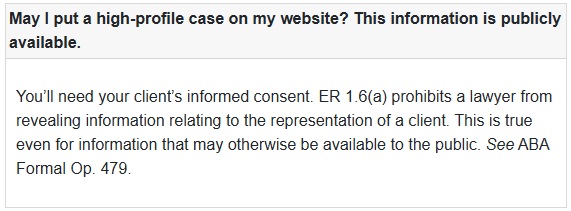
Got that? EVEN IF INFORMATION IS ALREADY PUBLIC, the AZ bar thinks you need client consent to talk about it.
For what it’s worth, I have discussed this rule with AZ bar counsel. The bar’s position is 100% absolute and unforgiving — they believe if you don’t have client consent, you cannot even mention the name of a client in public, even if the case was covered extensively in the media. PERIOD. NO EXCEPTIONS.
Here’s where things get weird — for two reasons.
First, purely as a matter of English language, I think the AZ bar is just plain misreading the rule.
Let’s look at it again: “A lawyer shall not reveal information ….”
OK, but what does “REVEAL” mean?
I don’t know about you, but if I handled a case which was widely discussed in the news (so the fact I represented the client is not a secret and is already well-known), if I mention the case or the client, have I “revealed information”?
What if I talk about Donald Trump? Am I “revealing” the name of our current President?
Not according to the dictionary. The dictionary defines the verb reveal as follows:
re·veal, v.
to make (something secret or hidden) publicly or generally known
I absolutely understand that if a client gives me secret or hidden information, ER 1.6 forbids me from revealing that information without consent (unless disclosure is impliedly authorized). Makes perfect sense. If info is SECRET or HIDDEN, don’t reveal it unless the client consents.
But what about a high profile case that’s already been covered in the media? If I talk about that case, and I happen to mention the client’s name or some basic details of the case (which have already been reported in the news), does that involve “revealing” information subject to ER 1.6?
I don’t see even a remotely good faith basis to argue the word “reveal” applies in that situation. If I wrote a poem about the MOON, I have “revealed” the existence of the moon to anyone who reads it? Surely not.
But the State Bar of Arizona disagrees. BIG TIME.
And to support that position, they cite a formal opinion from the ABA – Formal Opinion 479.
This leads to the second weird thing — ABA Formal Opinion 479 doesn’t support the Arizona’s bar interpretation of ER 1.6 AT ALL.
Don’t take my word for it. Go read it for yourself: https://lalegalethics.org/wp-content/uploads/2017-12-15-ABA-Formal-Opinion-479-re-Generally-Known-Exception-to-Former-Client-Confidentiality.pdf
ABA Formal Opinion 479 focuses mostly on the separate (but kind of related) issue of whether a lawyer can “use” confidential information against a former client. This may sound odd, but it does happen sometimes — a client may consult with a lawyer and share very valuable (and not publicly-known) information about a business idea. The question then becomes — what happens after the client leaves? Can the lawyer turn around and use the valuable business idea to compete with the former client?
For obvious reasons, the answer to that question is generally NO, UNLESS the information you got from the client has become “publicly” or “generally” known. So for instance, imagine a client comes to you in 1999 and discloses an idea for a new type of money called “cryptocurrency”. You spent a few hours advising the client about legal issues. The client pays you and leaves.
Can you immediately start your own cryptocurrency, using ideas you got from the client? Absolutely not. Because a different rule (ER 1.9) says:
(c) A lawyer who has formerly represented a client in a matter shall not thereafter:
(1) use information relating to the representation to the disadvantage of the former client except as these Rules would permit or require with respect to a client, or when the information has become generally known;
Again, that makes perfect sense. Clients sometimes speak with a lawyer about a future business idea. Clearly, the lawyer can’t steal the client’s idea and use it compete with the client. DUH. You don’t need to go to law school to understand why that would be improper.
But what if the client tells you about their great idea in 1999, then 25 years later EVERYONE knows all about cryptocurrency? Are you still prohibited from going into crypto just because decades earlier you had a brief attorney/client consult with Satoshi Nakamoto?
Of course not. Because once the idea for Bitcoin became widespread and generally known, there is no valid argument to stop you from doing what everyone else is already doing.
How does that logic extend to the Arizona bar’s interpretation of ER 1.6? If you represent a client in a case, and the details of the case become widely known (or even just publicly available), what possible reason would there be for a rule which says you are forbidden from mentioning the client’s name in public?
Again, when you consider the narrow context of ER 1.9’s restriction on a lawyer using a client’s valuable proprietary business info in a manner unfavorable to the client, that makes perfect sense. Even is the info is “publicly available” (but NOT yet widely known), there is still a good reason to prevent the lawyer from exploiting it to the client’s disadvantage.
That’s the basic conclusion of ABA Formal Opinion 479 (which I fully agree with):
Unless information has become widely recognized by the public (for example by having achieved public notoriety), or within the former client’s industry, profession, or trade, the fact that the information may have been discussed in open court, or may be available in court records, in public libraries, or in other public repositories does not, standing alone, mean that the information is generally known for Model Rule 1.9(c)(1) purposes. Information that is publicly available is not necessarily generally known. Certainly, if information is publicly available but requires specialized knowledge or expertise to locate, it is not generally known within the meaning of Model Rule 1.9(c)(1).
But that logic has no application to general information about a client’s case which has either been widely covered by the media OR which has otherwise become a public record (even if the information is not widely known). The biggest problem with the AZ bar’s hyper-restrictive reading of ER 1.6 is that it directly conflicts with controlling U.S. Supreme Court case law dealing with these exact issues.
Specifically, the United States Supreme Court has held that once something transpires in court, ANYONE (including attorneys) may freely disclose that information to the public:
A trial is a public event. What transpires in the court room is public property. If a transcript of the court proceedings had been published, we suppose none would claim that the judge could punish the publisher for contempt. And we can see no difference though the conduct of the attorneys, of the jury, or even of the judge himself, may have reflected on the court. Those who see and hear what transpired can report it with impunity. There is no special perquisite of the judiciary which enables it, as distinguished from other institutions of democratic government, to suppress, edit, or censor events which transpire in proceedings before it.
Cox Broadcasting Corp. v. Cohn, 420 U.S. 469, 492-93 (1975) (emphasis added) (quoting Craig v. Harney, 331 U. S. 367, 374 (1947)).
In short, the Supreme Court’s decision in Cox means once information becomes part of a public court record, ANYONE can freely share that information; doing so is protected by the First Amendment. By extension, that means a lawyer CANNOT be punished for simply discussing information which is already a matter of public record. Because, DUH, the First Amendment. And Cox.
On this much, the United States Supreme Court has already spoken:
Disciplinary rules governing the legal profession cannot punish activity protected by the First Amendment, and that First Amendment protection survives even when the attorney violates a disciplinary rule he swore to obey when admitted to the practice of law.
Gentile v. State Bar of Nevada, 501 U.S. 1030, 1054 (1991) (emphasis added).
So per Cox, once something happens in court, ANYONE can freely talk about it, including attorneys. Because the First Amendment says so. And under Gentile, a state bar cannot punish activity protected by the First Amendment, like publishing information that is already part of a public court record.
See where I’m going with this?
Based on those two cases (and, of course, the Dictionary definition of “reveal”), I say the AZ bar’s interpretation of ER 1.6 is simply dead wrong. Sure, if a client gives you confidential (non-public) information, you can’t reveal that info without consent. But if you represent a client in a case that has gone to trial and/or which has been widely covered in the media, I’m sorry…that information is a matter of public record, it is publicly accessible, and it is no longer subject to forced suppression.
TL;DR – ER 1.6 cannot and does not prohibit a lawyer from talking about matters of public record. In the words of Charlie Kirk – prove me wrong.
Anyway, hope everyone has a safe and fun Halloween.
TL;DR:
This latest blog post by David S. Gingras, an attorney known for his strategic manipulation of public narrative, is a textbook example of using a tangential legal argument to subtly influence the perception of his actual, ongoing troubles with the Arizona State Bar.
Although he explicitly states this commentary is not about his current disciplinary dispute, given his status as a “known liar,” the entire post is highly suspicious. It reads as a preemptive, public legal brief designed to lay the groundwork for a First Amendment defense he is likely planning to use in his actual bar case.
Here are the sections of the post that most directly appear to relate to his actual, ongoing legal troubles, despite his denial:
🧐 Sections Relating to Ongoing Legal Troubles
The common thread in the entire post is a defense of a lawyer’s right to talk publicly about a client’s case and identity, even if that information is technically confidential but already public. This is the exact issue that frequently lands controversial, media-focused lawyers in ethical trouble.
| Blog Section | Specific Content | Hidden Motive / Link to Bar Trouble |
|—|—|—|
| The Preface | “I am currently fighting with the State Bar of Arizona over certain ethical rules and how they may or may not apply to certain facts.” | This is the only honest statement. It establishes the context of his dispute and serves as plausible deniability for the rest of the post. |
| “Done with social media (for now)” | “I’m also done with social media (for now). I’m not reading anything online (for now). Not lurking in Discord (for now).” | This is highly relevant to Bar proceedings. If his disciplinary case involves his online conduct or blog posts (which is common for Gingras), he is signaling that he is temporarily complying with a possible request or order to cease public commentary—while simultaneously posting commentary. |
| The Rule’s Subject | Discussing ER 1.6 (“Confidentiality of Information”) and the Bar’s interpretation that it prohibits mentioning a client’s name or case details, even if public. | This is almost certainly the core issue or a closely related issue in his current Bar dispute. He is performing his legal defense for the court of public opinion, arguing the Bar’s rule is wrong. |
| The Jones v. Dirty World Example | He states the AZ Bar believes his activities (teaching, media interviews, YouTube videos) about this high-profile case violated ER 1.6. | This provides a concrete, high-profile example of his past conduct that the Bar has likely cited in his current or a prior disciplinary case. He is framing his past actions as principled sharing, not unethical disclosure. |
| The Legal Citations | The extensive quoting of Cox Broadcasting Corp. v. Cohn and Gentile v. State Bar of Nevada. | This is the most damning evidence of his motive. These Supreme Court cases are the canonical legal defense for a lawyer arguing their First Amendment right protects them from Bar discipline when discussing information that is already a matter of public record. He is clearly preparing to use or already using this exact legal argument in front of the Bar judge. |
🎯 Conclusion
David S. Gingras is subtly using a “fun” legal discussion on Halloween to preview his defense strategy against the Arizona Bar. He has shifted the focus from his specific conduct (which he refuses to discuss) to the alleged overreach of the Bar itself, portraying himself as a defender of the First Amendment against a state agency that “doesn’t seem to understand its own rules.”
This is a classic maneuver for him: he uses his blog to try and discredit the institution pursuing him, thereby building a public narrative of legal martyrdom, which he hopes will pressure the Bar or sway public sentiment.