This is probably WAY too technical for most people, but below is a video talking about Arizona’s anti-SLAPP law and the Motion to Dismiss I just filed. It’s an important law that is not well-understood, so I wanted to shed some light on why it matters so much.
Tech Note: My comments use the term “anti-SLAPP”, but this is technically a misnomer. Here’s why — let’s start with California’s anti-SLAPP law, Cal. Code. Civ. P § 425.16. When California first coined the term, they were focused on stopping Strategic Lawsuits Against Public Participation.
Arizona’s law differs from California’s in one BIG way — CA’s anti-SLAPP law only applies to civil lawsuits, hence the term “strategic LAWSUITS”.
By comparison, Arizona’s law is not limited to civil suits. It goes much further. It applies to ANY legal process used to suppress speech. This includes civil suits, but it also includes criminal charges (a nationwide first) and “any regulatory or administrative action by a state actor.” Bar discipline cases are, by definition, a form of regulatory action by a state actor. This is why Arizona’s law has a slightly different title than California – “Strategic Actions Against Public Participation” or “SAAPP”. Despite this, I will continue to use the more familiar term, SLAPP.
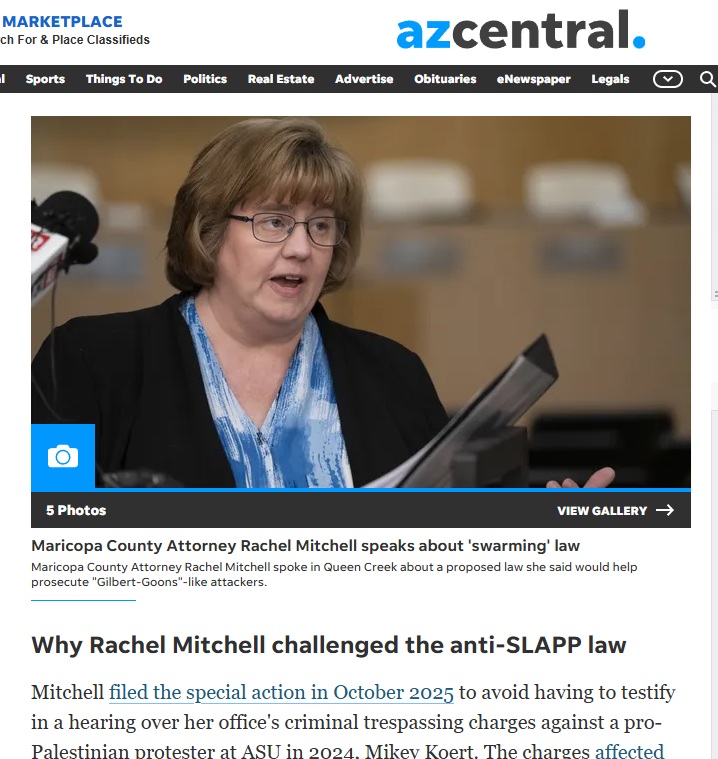
Also, fun fact – as I was writing this, Randazza literally texted me to say that our good friend, and completely 100% cishet DA, Rachel Mitchell, just LOST an attempt to strike down the anti-SLAPP law: https://www.azcentral.com/story/news/local/arizona/2026/04/16/arizona-anti-slapp-law-upheld-by-judge-vs-rachel-mitchell/89626153007/
OOPS. And the judge’s decision contains many, many good quotes that I can use later: State v. Michaela Joy Koert, LC2025-000363-001, Under Advisement Ruling (filed 4/15/2026).
One of the BEST aspects of the ruling was this — Rachel Mitchell tried to argue the AZ anti-SLAPP law violated the Arizona Supreme Court’s exclusive authority to create rules of procedure. She said ONLY the AZ Supreme Court can create procedural rules (which is true). Thus, she argued the anti-SLAPP law didn’t apply in criminal cases because the AZ Supreme Court has never adopted it as part of the criminal procedure rules (this is technically a “separation of powers” argument).
This has not come up in my bar case yet, but Jim Lee will probably TRY to make the same argument — that bar cases fall under the AZ Supreme Court’s “exclusive” duty to regulate the practice of law, and therefore the AZ anti-SLAPP law (which is not mentioned in the Supreme Court procedural rules for discipline case) does not apply to me.
The trial judge just slapped that argument right out of Rachel Mitchell’s mouth with this:
The legislature may not abrogate judicially-created rules of procedure. Seisinger v. Siebel, 220 Ariz. 85 (2009). To determine whether a statute impermissibly infringes on our Supreme Court’s procedural rulemaking authority, courts evaluate whether (1) there is a conflict between the statute and the rule, and (2) the statute is a substantive or a procedural law. State v. Brearcliffe, 254 Ariz. 579, 585, (2023). “Substantive law creates, defines and regulates rights” whereas a procedural law “prescribes the method of enforcing such rights or obtaining redress.”
This [anti-SLAPP] statute creates an affirmative defense to otherwise meritorious criminal actions where the motivations behind those actions are constitutionally impermissible. This is a substantive rather than procedural law and therefore this statute is not an unconstitutional infringement on the Supreme Court’s procedural rulemaking authority.
That is 10000% correct. The anti-SLAPP law create a REMEDY for victims of illegal state action. It does not change the rules of procedure for bar discipline cases; it simply says that IF a state actor like Jim Lee breaks the law, I have the right to get the case tossed, and Jim Lee must pay me for the damage he has caused.
Now as for my anti-SLAPP stuff, these pleadings have already been shared, but I’ll add them for efficiency:
- Motion to Dismiss A.R.S. § 12-751 / Motion for Summary Judgment
- Statement of Facts
- Gingras Affidavit
- Motion to Exceed Page Limits
Coming Soon (links TBD):
- PDJ Order Finding Respondent Has Failed to Make Prima Facie Showing That Case Involves Lawful Exercise of Rights
And Maybe Later:
- State Bar’s Response
- State Bar’s Controverting Statement of Facts
- PDJ’s Order Denying Motion to Dismiss/Summary Judgment
Here’s my video explainer (which I posted to Rumble, but that’s just a test):
Pingback: New Bar Judge Ruling – Kind Of A Win, Almost 🏆 – Gingras Law Office, PLLC