Today was, without question, one of the strangest days in my professional life. I HATE long blog posts, so I am not even going to try to scratch the surface.
Instead, two small points (which of course will run long):
1.) Had a conference call this afternoon with an Assistant AG who is representing the Commission on Judicial Conduct (CJC). The short version: the CJC does not want to hand over Mata’s response to my complaint (or anything else).
When I asked what basis the CJC had to object, the response was: “Well, our rules say we don’t have to comply without a court order.”
My response: “What rule are you referring to?”
CJC lawyer’s reply: “Commission Rule 9.”
Me: “You realize Rule 9 does not say ANYTHING about court orders? In fact it says exactly the opposite. The actual text of the rule says:
It [the CJC] may also disclose confidential information to confirm a pending investigation in a case in which an investigation has become public or to clarify proceedings in such a case; to protect individuals, the public, or the administration of justice; and to comply with official requests from agencies and other organizations involved in criminal prosecutions, bar discipline investigations, or judicial nomination, selection, and retention proceedings.
Me: “You understand a subpoena is an official request, right? And Rule 9 says you can release confidential information to comply with that sort of thing, right?”
CJC lawyer: “Yeah, well the rule only says the CJC MAY comply with those, not that we must. And in this case, we don’t want to. So we aren’t going to.”
Me: “Can you explain WHY you don’t want to? I accused a judge of misconduct. The CJC said the evidence did not support my claim. The bar is now claiming I lied. Wouldn’t it be HELPFUL to now show the evidence that proves I was wrong? That would actually HELP the bar and HURT me?”
CJC lawyer: “Sorry, a court order is required.”
OKAY, so a court order we shall get. I’ve already started drafting that motion. I’ll file it as soon as the CJC gives me their final, written objection (oops – that was just received while I was drafting this, so I’ll get that filed tomorrow).
2.) Jim Lee gave me his disclosure statement today. This is supposed to include all the evidence the bar has against me. It is also supposed to include the names of all witnesses, and a “fair summary” of what each person is going to say, etc. It’s also supposed to include cites to case law that supports the bar’s position.
Right now (and this IS subject to change), the bar is only listing THREE witnesses: 1.) ME, 2.) MATA, and 3.) a “custodian of records” from the bar. Unfortunately, the bar disclosed almost no detail about what Mata is going to say, but that’s an issue I will address later. At least we know she IS going to answer questions. FINALLY. Another prediction JFC got wrong.
But that’s not what caused me the most concern. Here’s what made me lose my breath for a second — Jim Lee’s disclosures include a LOT of case law which he says supports his position (his position being that the First Amendment doesn’t apply to me). He cited so many cases, it caused me some pause — hang on, does Jim Lee know something I don’t? Because I REALLY thought I knew the First Amendment stuff pretty well. Did I miss something?
I always trust but verify, so I started pulling the cases he cited…and wouldn’t you know it…..um, uh, well. Look – it is a VERY common thing in litigation for a lawyer (say, Queen Jennifer) to cite a case and CLAIM it supports their position (like Jennifer did with In re Seare). But then when you go read the case (like I did with Seare) you see it either doesn’t say what the other lawyer claims, or it says exactly the opposite.
This is SO common. It’s also technically not something the ethical rules permit…but let’s not go there right now.
Instead, let’s just look at ONE example of a case cited by Jim – In re Sitton. This is directly from his disclosure, and you can see the parenthetical he added to summarize the case holding:
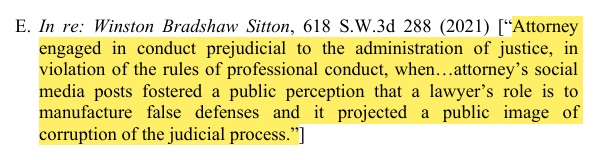
Hmm. OKAY. Lawyer + bad social media post = trouble.
But does this actually help Jim? Kinda sounds like it, right?
But let’s dig a little deeper. What exactly did Mr. Sitton do? Was it similar to things I’ve posted?
Let’s take a look:
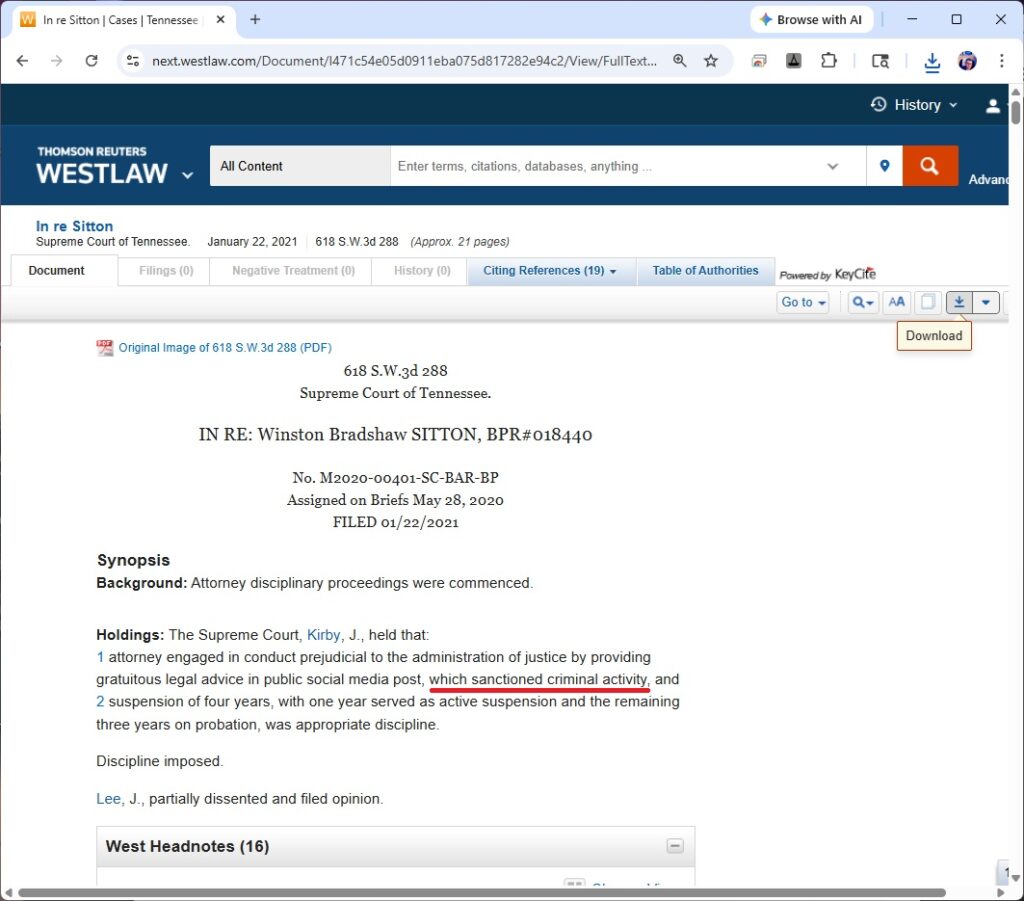
OKAY, but surely they don’t mean actual criminal activity, right? SURELY they’re talking about a lawyer’s joke, or just maybe a little advice on how to cheat on your taxes, right? Or how to evade a speeding ticket, right? Couldn’t be this guy was talking about serious criminal activity….right?
Well, let’s just quote directly from the decision:
This case is a cautionary tale on the ethical problems that can befall lawyers on social media. The attorney had a Facebook page that described him as a lawyer. A Facebook “friend” involved in a tumultuous relationship posted a public inquiry about carrying a gun in her car. In response to her post, the attorney posted comments on the escalating use of force. He then posted that, if the Facebook friend wanted “to kill” her ex-boyfriend, she should “lure” him into her home, “claim” he broke in with intent to do her harm, and “claim” she feared for her life. The attorney emphasized in his post that his advice was given “as a lawyer,” and if she was “remotely serious,” she should “keep mum” and delete the entire comment thread because premeditation could be used against her “at trial.”
In re Sitton, 618 S.W.3d 288, 290 (Tenn. 2021).
Ah, OKAY, so….murder. Mr. Sitton was trying to help coach someone on how to murder another person. Not really the same thing as calling JFC “assholes”.
I wonder if Mr. Sitton worked/works for ICE? Oops, apparently not [link]. RIP Mr. Sitton.
Folks….I said it before, and I will say it again: SLAPPs (strategy lawsuits against public participation) are never about winning. They are just about harassing and torturing the victim to the point they lose all hope and give up.
This is what that looks like.